 讲知识 · 讲经验 · 讲未来
 人人可分享 · 处处是课堂
 科技 · 财经 · 游戏 · 快讯,每日更新
 诚搜315观察网
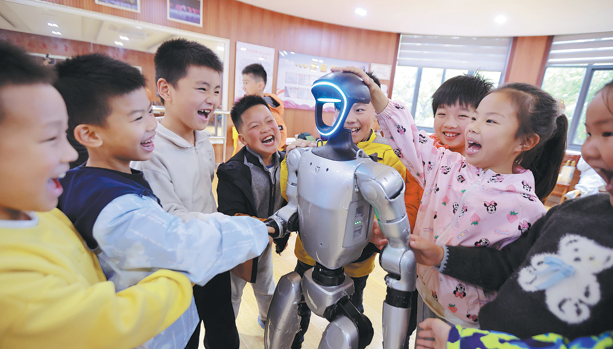
Children interact with a humanoid robot at Wutang community in Yangzhou, Jiangsu province, on Monday.
As artificial intelligence moves into the realm of real-world applications, global business leaders are calling for closer cooperation across the Asia-Pacific region to translate advances in AI into tangible productivity gains and broader economic opportunities.
Poh-Yian Koh, president of FedEx China, said the next phase of AI adoption will be defined by how effectively businesses translate technology deployment into better decisions, stronger productivity and measurable customer value. "The objective is not automation for its own sake, but tangible improvements in business performance," Koh said.
Robin Li, cofounder, chairman and CEO of Baidu, said that the ultimate value of AI would be realized at the application level.
Although investment in computing power, cloud resources and token consumption has risen rapidly, many companies are yet to see significant improvements in revenue and profits after adopting AI, Li said at the Asia-Pacific Economic Cooperation CEO Summit 2026 in Shenzhen, Guangdong province, on Tuesday.
"The most urgent task is to identify the scenarios where AI is truly suited," he said, warning that AI risks becoming a bubble if technological advances do not translate into practical business value.
The focus on AI's practical value can be seen across industries.
Yang Ting, vice-president of Agilent Technologies and general manager for Agilent China, said that at the life sciences company, AI is being integrated into instruments and laboratory workflows to help customers make faster decisions, improve data quality and raise efficiency.
"For businesses across APEC, the opportunity is to start with real challenges, demonstrate value and scale what works," Yang said.
Fang Ling, president of Alstom's Asia-Pacific region, said the rail technology company can improve reliability, anticipate equipment failures and make maintenance more efficient with AI. "Rail is a safety-critical industry, so AI needs to be combined with reliable data, deep engineering expertise and rigorous validation," Fang said, noting that technologies must be tested in real operating environments before wider adoption.
Practical applications also bring governance and skills to the fore. Businesses need high-quality data, connected systems and clear governance to scale AI responsibly, FedEx's Koh said, adding that employees should combine AI-driven insights with professional expertise and sound judgment.
Executives also see China's "AI Plus" initiative and its diverse industrial application scenarios as important opportunities for multinational companies to accelerate AI adoption and develop solutions around real business needs.
They also called for closer cooperation among APEC economies to share practical experience, expand digital skills and make AI applications more accessible across industries.
Contact the writers at lijiaying@chinadaily.com.cn
来源:中国日报