 讲知识 · 讲经验 · 讲未来
 人人可分享 · 处处是课堂
 科技 · 财经 · 游戏 · 快讯,每日更新
 诚搜315观察网

The skyline of Hudong, an area east of Jinji Lake in Suzhou Industrial Park, East China's Jiangsu province. Launched in 1994, SIP has grown into a symbol of bilateral cooperation between China and Singapore.
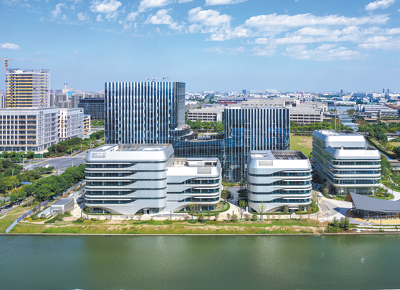
Biosparc, a new hub in SIP dedicated to biomedicine, digital healthcare technologies and other areas.

An architectural rendering of the first phase of the China-Singapore Green Digital Hub in SIP.

The China-Singapore Embodied Intelligence Industrial Park in SIP, which includes an industrial ecosystem center and industrial parks dedicated to embodied intelligence.
The 27th China-Singapore Suzhou Industrial Park Joint Steering Council Meeting was held on Monday in Singapore to review and advance bilateral cooperative achievements and initiatives related to Suzhou Industrial Park.
The council, created by the Chinese and Singaporean governments, serves as a high-level coordination body for shaping the strategic direction of SIP. Launched in 1994 as the first government collaboration between China and Singapore, SIP has grown into a symbol of bilateral cooperation between the two nations.
Spanning 278 square kilometers, with 80 sq km dedicated to China-Singapore cooperation, SIP has become a global window into China's transformation and the economic rise of Suzhou and Jiangsu province.
Over more than three decades, SIP has recorded tax revenues of 1.2 trillion yuan ($180 billion), 1.2 trillion yuan in fixed-asset investments and an import-export volume of $1.7 trillion. In the first three quarters, SIP achieved a regional GDP of 324.14 billion yuan, marking a year-on-year growth of 6.2 percent.
These achievements have earned the park recognition in national economic and technological rankings. It has ranked first in the comprehensive assessment of national economic development zones for many years, while rising to fourth place among national high-tech development zones.
Pioneering biomedicine
Biomedicine and the healthcare industries represent core areas of focus for SIP. After 20 years of development, SIP has created an ecosystem that spans the biopharma value chain, including research and development, commercialization and production, bringing together well-established enterprises from home and abroad.
The recent opening of Biosparc on Nov 18 marks the birth of a new hub connecting the biomedicine and healthcare industries with global innovation resources. The first phase of the project covers an area of approximately 2.6 hectares with a total investment of 840 million yuan.
Biosparc is jointly developed by Sungent Holding Group based in Suzhou, Temasek based in Singapore and NRL Capital. Leveraging SIP's foundation in the biomedical industry, technology, talent, investment and services, along with Temasek's advantages in global innovation networks and international capital markets, Biosparc features world-class R&D facilities and a full-cycle service system. It aims to advance innovation in the life sciences sector, providing support for enterprises specializing in drug R&D, medical devices, digital healthcare and artificial intelligence applications in healthcare.
To date, organizations such as the National Cancer Centre Singapore, Essex Bio-Technology and Mirxes have established a presence in SIP. Collaborations between companies such as Visirna Therapeutics and Sanofi, and BioDlink and Wuxi XDC, demonstrate the park's evolution from merely producing biomedical products to serving as an international hub for innovation.
Leading the intelligent era
Embodied intelligence, a pivotal frontier in the next generation of AI, has emerged as a focus area for future China-Singapore collaboration. Embodied intelligence integrates cognitive systems with physical mechanisms to create intelligent agents that perceive and interact with the real world, driving major advancements in productivity and automation.
In late October, more than 10 embodied intelligence enterprises from SIP participated in the 2026 Singapore Week of Innovation and Technology, connecting with Singaporean and global partners.
During the event, Suzhou Junji Robotics Technology unveiled its advanced manufacturing production line model, LineMind, overseas for the first time. Leveraging this model, the time required for senior engineers to complete preliminary production line design has been reduced from seven days to just one hour.
In SIP, more than 150 companies now operate within the embodied intelligence sector, forming a complete industrial chain encompassing core components, hardware development and system integration. This ecosystem highlights the complementary strengths of the two-way partnership. While SIP's industrial foundation and diverse application scenarios provide fertile ground for innovation, Singapore contributes its highly internationalized innovation landscape and expertise in financial services.
On Nov 10, the 20th meeting of the Singapore-Jiangsu Cooperation Council took place in Suzhou. During the event, a subsidiary of China-Singapore Suzhou Industrial Park Development Group that focuses on embodied intelligence signed strategic cooperation agreements with Singapore's Agency for Science, Technology and Research, the Robotics Society of Singapore and Singaporean company Ability Robotics.
These collaborations aim to foster partnerships in areas such as the China-Singapore embodied intelligence industrial ecosystem, the establishment of a center of excellence in Singapore for embodied intelligence applications, and the joint development of centers for data collection, processing and model training in embodied intelligence. These efforts are paving the way for new directions in Singapore-Jiangsu cooperation.
The 2024 China-Singapore Investment Forum witnessed the signing of the agreement to build the China-Singapore Embodied Intelligence Industrial Park. Developed by China-Singapore Suzhou Industrial Park Development Group, this project includes an industrial ecosystem center and industrial parks dedicated to embodied intelligence.
The industrial ecosystem center, which became operational in February, integrates functions such as innovation, incubation, production and exhibition. The Suhong industrial park and the first phase of the Jinguang industrial park have been completed.
Leveraging these platforms, exchanges and cooperation in the field of embodied intelligence continue to gain momentum. As of September, the China-Singapore Embodied Intelligence Industrial Park had signed 23 embodied intelligence projects and hosted more than 10 themed industry events.
Promoting green growth
The main construction of Phase I of the China-Singapore Green Digital Hub, located in the northern part of SIP, was recently completed.
The first phase, projected for full completion in March 2028, comprises five mid-rise R&D office buildings and one high-rise apartment hotel. It focuses on attracting green industries centered on low-carbon technologies, alongside emerging service sectors featuring digital technologies.
Jointly developed by Sungent Holding Group, Singapore-based global asset manager and operator Keppel, and Singaporean consultancy SJ Group, the China-Singapore Green Digital Hub exemplifies the two nations' shared vision for sustainable growth. It strives to become a net-zero smart park that promotes low-carbon industrial practices, green energy transformation, shared resources and circular operations.
In Singapore, similar sustainability efforts are advancing. The pilot project for mobile smart charging stations, spearheaded by China-Singapore Suzhou Industrial Park Green Development, offers new solutions for electric vehicles in Singaporean industrial parks such as the Punggol Digital District.
Beyond sustainability, China and Singapore have furthered their cooperation in digital trade. Responding to the importance of global connectivity, SIP has worked to align itself with international digital trade protocols, advancing innovations in cross-border data flows and the digitization of trade documents. These efforts aim to deepen international cooperation in digital trade.
Notably, SIP has launched China's first pilot program for bilateral cooperation in digital trade and is developing a China-Singapore digital trade cluster, exploring new solutions in digital identity recognition and cross-border data security.
The outcomes of bilateral collaborations between the two nations underscore the potential of partnerships built on complementary strengths and shared goals.
huyuyan@chinadaily.com.cn
来源:中国日报