 讲知识 · 讲经验 · 讲未来
 人人可分享 · 处处是课堂
 科技 · 财经 · 游戏 · 快讯,每日更新
 诚搜315观察网
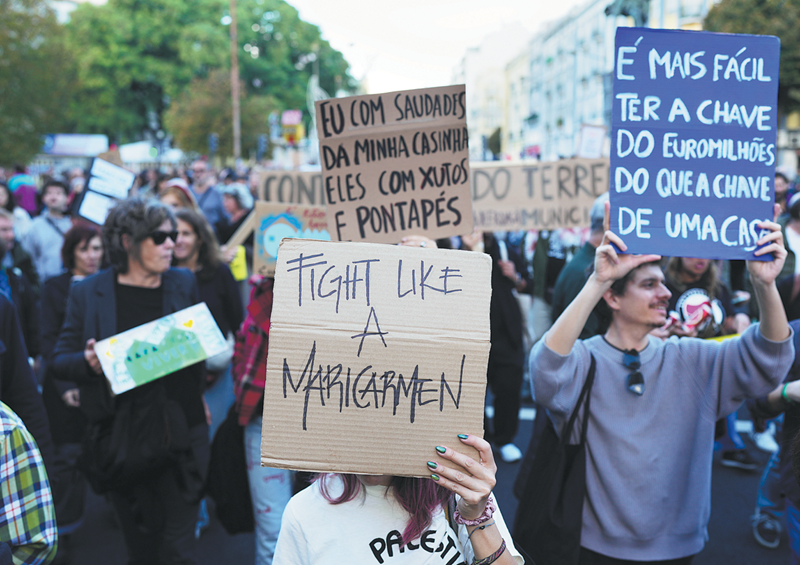
A protester (front) holds a sign reading "Fight like Maricarmen", referring to 87-year-old Maricarmen, whose fight against eviction drew attention to Spain's housing crisis, during a demonstration demanding affordable housing in central Lisbon on Saturday.
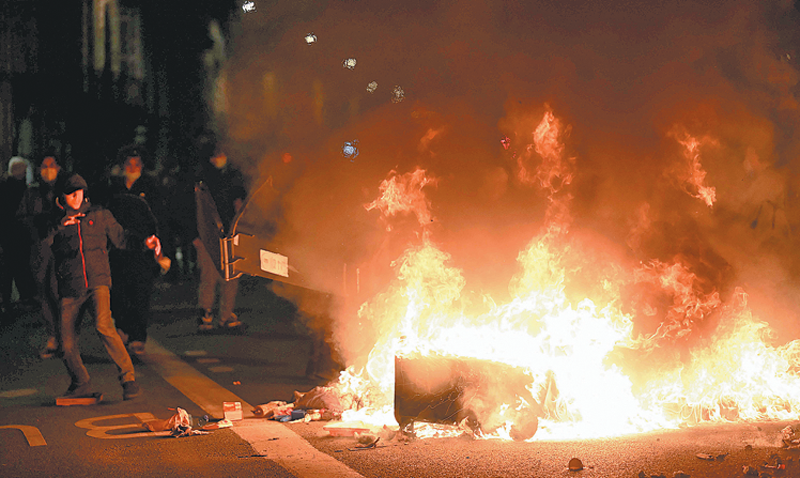
Protesters set fire to rubbish after a demonstration in Bordeaux, France, on Saturday, as part of a nationwide protest against the rising cost of living and inequality.


<b>Online</b> See more by scanning the code.
A wave of protests has swept across Europe in recent months, reflecting growing public frustration over the cost of living, public services and government policies, experts say.
Millions of Spanish workers went on strike on Wednesday over housing costs, shutting businesses and disrupting transport ahead of a national election later this month.
The walkout, under the slogan "Salaries, housing, prices", was Spain's first general strike in 14 years. In Madrid, the action coincided with a teachers' strike that began nearly a month ago over working conditions.
The unrest in Spain is part of a broader wave of protests across Europe. In France, protests that began in September with students demanding school renovations, more teachers and university reforms later broadened into cost-of-living demonstrations involving trade unions and political activists. Some turned violent.
In Germany, demonstrations in more than 30 cities earlier this month called for greater investment in public services and measures to ease the cost of living, while opposing compulsory military service.
In Italy, protests over living costs and public services drew large crowds in more than 60 cities during a nationwide general strike called by the Unione Sindacale di Base. The union estimated that 1.5 million people took part, compared with the Interior Ministry's figure of about 255,000, the ANSA news agency reported.
In Poland, disputes over the composition and leadership of the Constitutional Tribunal have sparked demonstrations in Warsaw, adding to tensions over the country's constitutional institutions.
Tian Dewen, a researcher at the Chinese Academy of Social Sciences' Institute of Russian, Eastern European and Central Asian Studies, said widespread discontent over economic and livelihood issues was a common thread in the protests.
Neoliberal reforms introduced in the 1980s have continued for decades, yet they have failed to fundamentally improve the fiscal position of European countries, which in many cases has instead deteriorated, Tian said. A key reason is the region's sluggish economic growth.
The European Union's statistical office Eurostat said that seasonally adjusted GDP grew 0.6 percent in the eurozone and 0.7 percent in the EU in the second quarter from the previous quarter.
Meanwhile, aging populations and fewer young people have narrowed the tax base, squeezing government revenues as public spending continues to rise, Tian said.
Pensions make up the largest share of Europe's welfare spending. Raising the retirement age is a key measure to expand the contributor base and sustain social security systems, he said.
"However, even maintaining the current pay-as-you-go pension system has become increasingly difficult, largely because of sluggish employment growth," he added.
Gao Jian, director of the European Think Tank Research Center at Shanghai International Studies University, said European governments have long relied on borrowing to sustain their extensive welfare systems, but rising debt-servicing costs are taking up a growing share of public budgets.
"With limited scope for further tax increases or additional borrowing, governments are facing mounting pressure to rein in spending, including on social welfare, fueling public anger," Gao said.
The welfare state is increasingly shifting from a "social contract" toward a system of intergenerational transfers, he said.
"Population aging is driving up spending on pensions, elderly care and healthcare, while younger generations struggle to afford housing, secure well-paid jobs and find stable employment," he said. "The existing welfare model was largely built around assumptions of larger families, shorter life expectancies and sustained economic growth."
Geopolitical shifts
Zhang Jian, vice-president of China Institutes of Contemporary International Relations, said the unrest also reflects geopolitical shifts and changing domestic policy priorities in Europe.
"Prolonged cost-of-living pressures, coupled with cuts to welfare spending and social benefits, have further fueled public discontent with governments," Zhang said. "The protests are an outpouring of frustration built up over many years."
Geopolitical shifts and multiple conflicts have driven up inflation across Europe, straining government and household finances, he said. Meanwhile, European governments are increasingly prioritizing security and channeling substantial resources into military spending.
Against this backdrop, governments across the continent are cutting or seeking to cut welfare spending and raise taxes, further squeezing budgets for social protection and public services, he added.
Zhao Yongsheng, a professor of European studies at the University of International Business and Economics in Beijing, said Europe has lagged in developing and adopting new technologies, while economic growth remains sluggish.
For decades, Europe has relied heavily on traditional industries and a well-developed welfare system to drive economic and social development. But digital technologies, AI and the green transition are reshaping global competition, putting its traditional industrial strengths under increasing pressure, Zhao said.
These challenges have further strained public finances, he said.
"Many European countries face tight public finances, with public debt and budget deficits in several major economies continuing to rise," he said.
"Persistent inflation and geopolitical uncertainties, combined with these structural challenges, will be difficult to resolve in the short term," he added.
Agencies contributed to this story.
liujianqiao@chinadaily.com.cn
来源:中国日报