 讲知识 · 讲经验 · 讲未来
 人人可分享 · 处处是课堂
 科技 · 财经 · 游戏 · 快讯,每日更新
 诚搜315观察网
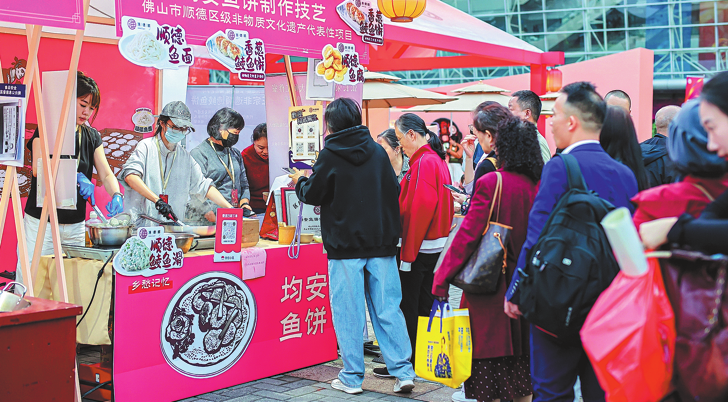
Fish cakes from Guangdong province draw visitors to the 9th China Intangible Cultural Heritage Expo in Chongqing in November.
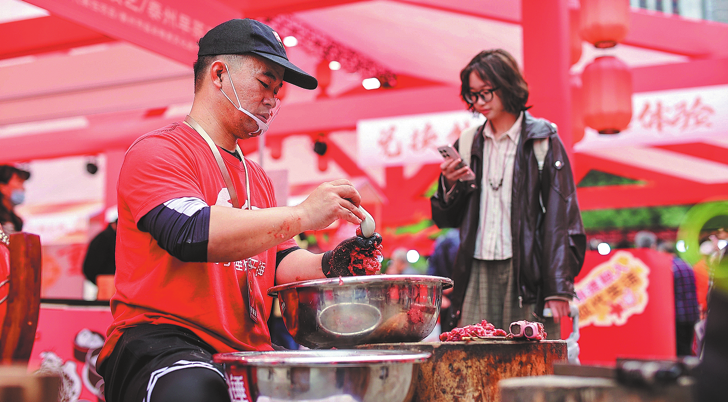
Liu Kunyang makes hand-pounded beef balls, a specialty from Guangdong's Chaoshan region.
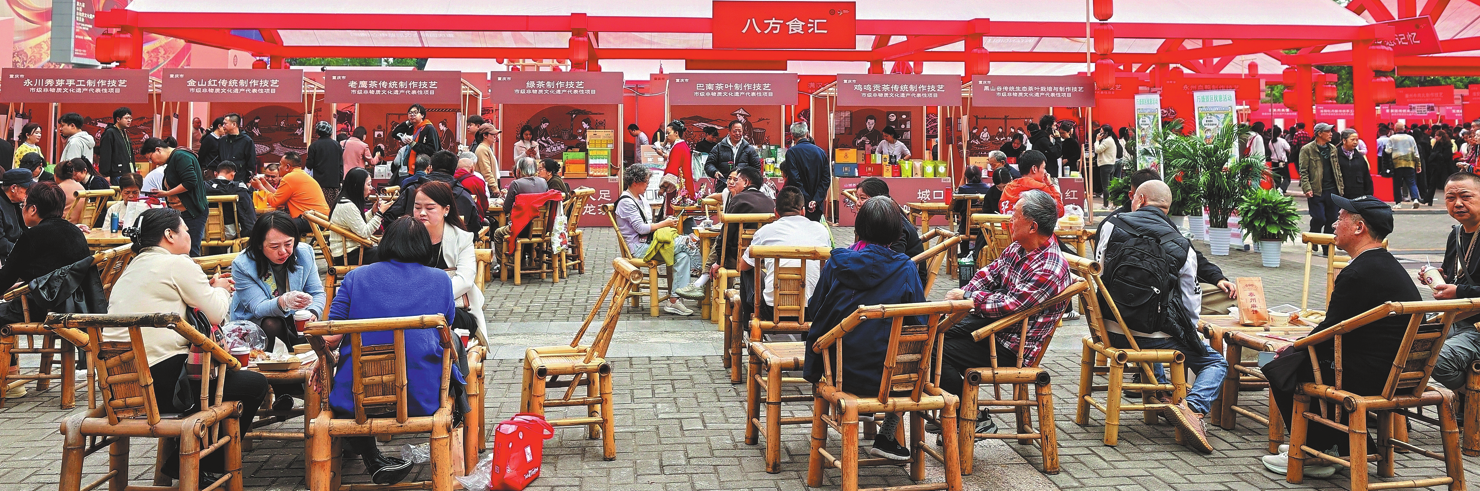
Visitors enjoy gourmet food.

Visitors sample hotpot dishes with varying levels of spiciness at the 9th China Intangible Cultural Heritage Expo.

From top: Fish cakes from Guangdong province, jianbing guozi from Tianjin, leicha (a traditional tea drink made by grinding tea leaves with nuts and seeds) from Hunan province and hand-pounded beef balls from Guangdong province are among major draws during the expo.

From top: Fish cakes from Guangdong province, jianbing guozi from Tianjin, leicha (a traditional tea drink made by grinding tea leaves with nuts and seeds) from Hunan province and hand-pounded beef balls from Guangdong province are among major draws during the expo.

From top: Fish cakes from Guangdong province, jianbing guozi from Tianjin, leicha (a traditional tea drink made by grinding tea leaves with nuts and seeds) from Hunan province and hand-pounded beef balls from Guangdong province are among major draws during the expo.

From top: Fish cakes from Guangdong province, jianbing guozi from Tianjin, leicha (a traditional tea drink made by grinding tea leaves with nuts and seeds) from Hunan province and hand-pounded beef balls from Guangdong province are among major draws during the expo.
The aroma of freshly made fish cakes drew a long queue to Zhang Changrong's booth at the 9th China Intangible Cultural Heritage Expo in Chongqing in early November.
"The more bones a mud carp has, the fresher its meat," Zhang told visitors, explaining why his family has relied on the freshwater fish, known for its many fine bones, to make Jun'an fish cakes for more than 140 years.
Removing the bones is one of the most time-consuming stages of the process. They must be picked out individually before the fish is pounded into paste.
"There is no rushing it," Zhang says.
A fifth-generation practitioner of Jun'an fish cake-making in Shunde, Guangdong province, Zhang carries on the family tradition.
"After the bones are removed, the fish meat is repeatedly pounded with salt, sugar and a little starch for about five minutes," he explains.
The mixture is then shaped and processed further. Each fish cake involves eight meticulous steps.
Machines can press the fish, Zhang says, but the texture is different from that of handmade fish cakes. The maker must judge when the fish has been pounded enough and when the paste is ready.
"You know by feel when the fish has been worked enough, and it is ready to take shape. That is how you get a consistent texture," he adds.
The family has also introduced variations that include scallions, dried tangerine peel, chili, and other ingredients, such as fish tofu and fish noodles.
Its business now extends beyond its home market, with products sold in Hong Kong and Macao and exported to Canada and the United States. The family also maintains a fish farm to source their own mud carp.
For Zhang, expanding the product range has not meant abandoning the traditional method.
"We just focus on making good products," he says.
A few stalls down at the Chongqing expo, the rhythmic clang of metal striking meat drew visitors to Liu Kunyang's display of hand-pounded beef balls, a specialty of the Chaoshan region in eastern Guangdong province, named after two of its major cities, Chaozhou and Shantou. It is also known for its distinct cuisine and musical traditions.
Known online as "Brother Thousand Hammers", Liu has turned a labor-intensive food-making technique into a performance that attracts audiences well beyond his hometown.
For an experienced worker, pounding 5 kilograms of beef takes about 70 minutes and more than 7,000 strikes. The repeated blows break down the meat and give the finished beef balls their springy texture.
"Many people like our Chaoshan hand-pounded beef balls because of their texture. That is the biggest benefit of hand-pounding the meat," Liu says.
He has also taken the craft to social media, making short videos that pair the rhythmic pounding of beef with Chaozhou gongs and drums and Yingge, a traditional folk dance popular in the Chaoshan region. The videos have attracted more than 10 million views.
But Liu wants people to do more than watch. Over the past three years, he has introduced the technique to more than 10,000 people through hands-on activities. At the Chongqing expo, he brought a wooden block and pounding tools so that visitors could try it themselves.
"The physical effort often comes as a surprise to first-time participants," he says.
Liu believes that trying the tools themselves gives visitors a better sense of the work behind the springy texture of hand-pounded beef balls.
At another booth, Liu Yushun demonstrated how technology helps reproduce the many steps involved in making Tianjin's traditional jianbing guozi, a savory pancake commonly eaten for breakfast in the northern city.
He spread green-bean batter over a hot griddle, turning his wrist to form a thin, round pancake.
"Making one serving involves 72 steps, and the batter contains 22 herbal ingredients," he says.
A traditional serving brings together four layers of aroma: the sauce, seasonings, egg, and the combination of the ingredients.
Making jianbing guozi involves more than getting the batter and fillings right. "The order and technique of each step also matter," he emphasizes.
Liu Yushun has also tested the limits of the pancake, once using 20 eggs for a single pancake in an online challenge.
"The pancake didn't break, and the eggs didn't burn," he says.
He has worked with a technology company to develop a machine that follows the traditional process, from spreading the batter and turning the pancake to adding scallions and sauces, folding it, and putting it into a bag.
The machine has gone through six generations of development and is now used by businesses across China and Singapore. Liu is also working on upgrades that would allow it to interact more naturally with customers, asking whether they would like more sauce or chili, much like a vendor at a street stall.
For him, technology is a way to reproduce the familiar process more consistently and make the breakfast available in more places, rather than replace the recipe with a new one.
At the expo's Hunan booth, Xie Yuan drew visitors' attention as he used a wooden pestle to grind tea leaves, peanuts, and other ingredients in a woven bamboo pottery, demonstrating the traditional craft of making taohuayuan leicha, a ground-tea drink named after a scenic area in Taoyuan county, Changde, where the tradition is rooted.
In Taoyuan county, leicha has long been served to guests and shared at family gatherings and festive occasions, he says.
The drink is made by grinding tea leaves, sesame seeds, peanuts, and other ingredients into a paste, and mixing it with hot water.
Xie grew up with the drink, as his parents ran a leicha business. After graduating from Hunan First Normal University with a degree in music in 2012, he worked in arts education in Shanghai and Changsha, Hunan province. He returned home in 2017 and began developing the family tradition into his own business.
In 2019, he won the title "Leicha King" in a competition held during the first Taohuayuan Leicha Cultural Festival. He later opened a shop near the Taohuayuan scenic area, introducing visitors to the local specialty.
Xie has also developed versions that are easier to store, carry, and deliver. Alongside the traditional savory flavor, his products include varieties with rose, nuts and perilla, as well as powdered and ready-to-serve options.
These adaptations are intended to make the drink more accessible to people who may not have the time or equipment to prepare it the traditional way.
"This craft has been passed down in my family. People in Taoyuan serve leicha to guests and to celebrate Spring Festival. It is an essential part of the occasion," Xie says.
Contact the writer at yangfeiyue@chinadaily.com.cn
来源:中国日报